It’s been a year filled with bleak survival thrillers, hasn’t it? From Ridley Scott’s The Dog Stars to David Ayer’s Heart of the Beast, the genre has really found a new lease of life in 2026.
The latest to join the club is Whalefall. Based on the novel of the same name by Daniel Kraus, this is a tense, claustrophobic and surprisingly emotional survival story that puts family dynamics at the heart of its premise. But is it actually any good?
Following the death of his father, Jay Gardiner (Austin Abrams, of Weapons and this year’s Resident Evil) heads out diving off the coast of California in search of his remains. However, things take a rather unexpected turn when he’s swallowed whole by a giant sperm whale. Trapped inside the animal, with his oxygen supply rapidly dwindling, Jay must figure out a way to escape before it’s too late.
Whalefall follows in the footsteps of those aforementioned survival stories by keeping its cast relatively small but seriously talented. Much of the runtime is spent with Abrams as Jay, a young university student whose relationship with his late father, played by Josh Brolin, was (and remains) complicated to say the least. Rounding out the cast are Elisabeth Shue as Jay’s mother, Zara, alongside Emily Rudd and Jane Levy as his sisters.
More than just a whale of a tale
Abrams is exceptional in the lead role. His performance, much like the film itself, feels grounded and raw. Jay isn’t just trying to figure out how on earth he’s going to escape the predicament he’s found himself in; he’s also wrestling with his feelings towards his father and the resentment he’s carried for years. It’s a difficult balancing act, but Abrams makes both sides of the character’s struggle feel convincing.

And while much of the film does take place inside a living whale, extended flashbacks take us back to Jay’s life on dry land, exploring the complicated and often painful relationship he shared with his dad. These sequences give Whalefall its beating heart, elevating it beyond the straightforward survival thriller you might expect from a premise like this. There’s considerably more emotional depth here than the marketing might suggest.
A terrifying plunge into the deep
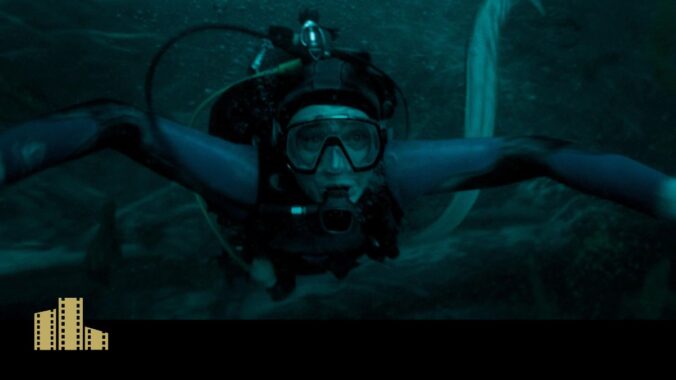
Of course, spending much of the runtime inside a living whale makes for an intensely claustrophobic experience. Those with a fear of enclosed spaces might want to think twice before diving in. Director Brian Duffield, in only his third feature film, makes masterful use of light and shadow to create an incredibly intimate environment that’s both beautiful and deeply, deeply horrifying to witness.
Clocking in at just over 100 minutes, Whalefall also continues the welcome trend of shorter films making their way into cinemas, and I’m absolutely here for it. Not every film needs to push towards the three-hour mark, after all.
That said, some critics of the adaptation have argued that this is a story that works better on the page than it does on screen, and I think there’s a fair argument to be made there. Certain elements of the story struggle to carry the weight they’re clearly intended to, partly because the film’s relatively limited locations restrict how much the story can expand beyond its central predicament. It’s an ambitious concept, but there are moments when the execution doesn’t quite match the scale of the idea.
Visually, however, Whalefall is a real treat, particularly as we venture into the deeper reaches of the ocean during the final third. The sequences beneath the surface take on an almost whimsical, ethereal quality, not unlike what audiences experienced with Life of Pi back in 2012 – trust me, you need to see them to understand my reasoning. The cinematography by Aaron Morton is a real strength throughout, but it’s in these final scenes that the film truly comes alive. Honestly, I wish more of it had this quality.
Family is at its heart
Ultimately, Whalefall is a film more interested in family dynamics than you might expect from a story about a man being swallowed by a whale. Don’t get me wrong: there are plenty of tense survival sequences, some brutal body horror and the terrifying prospect of being trapped in the depths of the ocean. But it’s the emotional undercurrent that lifts this above your more run-of-the-mill survival thriller.
It might not completely overcome the challenges of adapting its source material, but there’s enough here to make it worthwhile. Whalefall is an atmospheric, visually striking and unexpectedly moving film that proves there’s more than one way to get under your skin.


Leave a Reply