
Updated October 2026
Every so often, a film comes along that reminds you just how magical cinema can be. Ang Lee’s Life of Pi is one of those films. Based on Yann Martel’s 2001 novel of the same name, it’s a visually breathtaking, emotionally charged adventure that combines extraordinary filmmaking with a deeply moving story. But does Lee’s adaptation live up to the reputation of its source material? Absolutely.
From its stunning visuals and remarkable performances to its heart-warming central relationship, Life of Pi is a film that captivates from beginning to end. It’s an extraordinary cinematic experience, although it takes a little patience to fully appreciate just how special it is.
A breathtaking journey from page to screen
The film opens with something that has always been a pet hate of mine: the opening credits. I’ve often found that films which begin this way can struggle to grab my attention, but something about Life of Pi felt different. As the beautifully presented names flashed across the screen, I had a feeling I was in for something spectacular. Just how spectacular, however, I wasn’t quite prepared for.
At its heart, the story follows Pi Patel, charting his journey from childhood through adolescence and into adulthood. It might sound like a relatively straightforward coming-of-age tale, but the magic lies in how Lee brings Martel’s extraordinary story to life on screen.
The narrative begins in the present day, with a writer (Rafe Spall) searching for inspiration for his next book. He encounters the adult Pi (Irrfan Khan), who has an incredible story to share. As Pi begins recounting his experiences, we’re transported back to his childhood in India, where his family runs a zoo and life initially appears relatively idyllic.
However, that peaceful existence is disrupted when financial difficulties force the family to relocate to Canada. Along with their animals, they board a cargo ship and begin the journey towards a new life. It’s a decision that will change everything.
When disaster strikes at sea
As the family makes its way across the ocean, a devastating storm strikes the vessel, leaving Pi stranded and his family presumed lost. It’s a harrowing sequence, with Lee capturing the sheer scale and destructive power of the ocean in a way that is both spectacular and deeply unsettling.
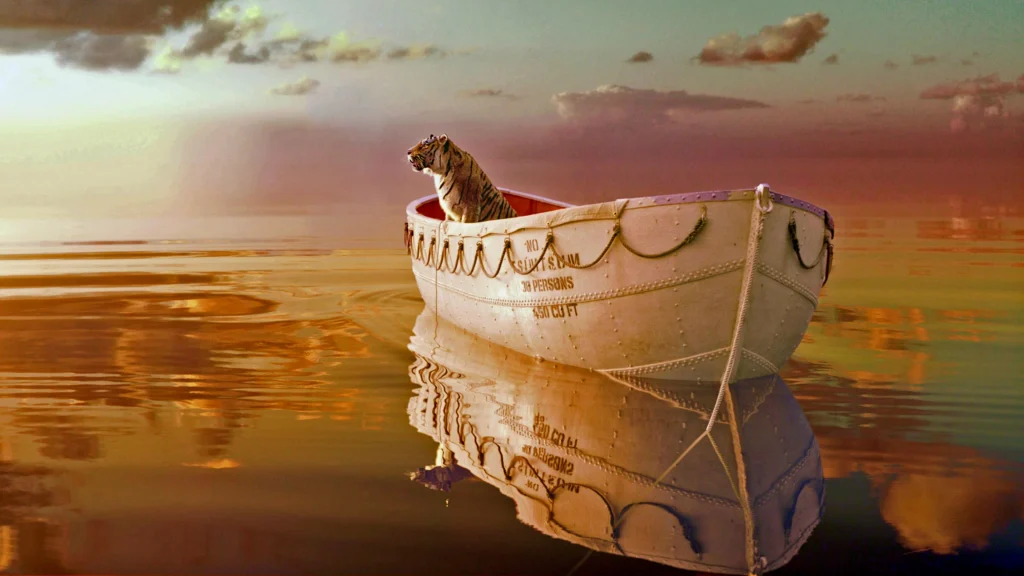
Miraculously, Pi survives and finds himself in a small lifeboat alongside an injured zebra, a hyena, an orangutan and Richard Parker, a Bengal tiger. Unsurprisingly, sharing such a confined space with a group of wild animals doesn’t exactly make for a peaceful voyage. Before long, the natural order of things takes over, and Pi is left to contend with a rather more dangerous travelling companion.
Richard Parker becomes the focal point of the film, and the relationship between him and Pi is fascinating to watch. Initially, their situation is a constant battle for survival, with Pi having to find a way to coexist with an animal that could kill him in seconds. Keeping his distance is the only sensible option, so he constructs a makeshift raft and tries to maintain a safe separation from the tiger.
As the days pass, however, their relationship begins to evolve. There are some wonderfully amusing moments along the way, including encounters involving flying fish and a rather unconventional approach to sharing the boat. Yet beneath the humour is something much more compelling: an uneasy companionship between two creatures who, against all odds, need one another to survive.
Richard Parker steals the show
Richard Parker is a remarkable achievement in filmmaking. Created through a combination of real tigers, CGI and animatronics, he looks astonishingly lifelike. More importantly, Lee manages to give the animal a genuine presence and personality without resorting to making him overly human. Richard Parker doesn’t need to speak or wear his emotions on his sleeve; his movements, expressions and behaviour do all the work.
Credit must also go to Suraj Sharma, who plays Pi in his feature-film debut. Much of the film rests on his shoulders, particularly during the extended stretches at sea when he’s largely carrying the story on his own. It’s a physically demanding and emotionally complex role, but Sharma delivers a performance that feels completely convincing. He captures Pi’s fear, determination, vulnerability and resilience beautifully, making it remarkably easy to invest in his journey.
A visual feast for the eyes
Then, of course, there’s the visual spectacle. Life of Pi is an absolute feast for the eyes, with Lee using colour, light and perspective to transform the ocean into something that feels almost otherworldly. The 3D is particularly effective, enhancing the experience rather than distracting from it. Every frame feels carefully considered, and there are several sequences that are genuinely extraordinary.
Without giving too much away, the scenes involving glowing jellyfish and the film’s extraordinary island inhabited by meerkats are among its visual highlights. They’re the sort of moments that need to be experienced on screen to be fully appreciated. The imagery is imaginative, often surreal and occasionally breathtaking, demonstrating just how much a filmmaker can achieve when visual storytelling is allowed to take centre stage.
A story with real heart and soul
But what makes Life of Pi truly special is that there’s considerably more to it than impressive effects and beautiful cinematography. Beneath all the spectacle lies a huge emotional core: a story about survival, companionship, grief and the human instinct to keep going, even when all hope appears lost.
The bond between Pi and Richard Parker is deeply moving, particularly as their time together forces Pi to confront his own fears and discover reserves of strength he never knew he possessed. There are some genuinely heartbreaking moments, and I wouldn’t be surprised if a few viewers find themselves reaching for the tissues before the credits roll.
There’s also a fascinating religious dimension running throughout the film. Pi’s relationship with faith is a central part of his identity, and the story explores what it means to believe in something greater than yourself when life throws seemingly impossible challenges your way. Whether you connect with that spiritual element or not, it’s an important part of the film’s wider message, adding another layer to an already rich story.
Ultimately, Life of Pi is something really special. It’s a magical, visually stunning journey that manages to engage the eyes, the heart and the mind in equal measure. Lee’s direction is exceptional, Sharma gives a remarkable performance, and the creation of Richard Parker is a technical achievement that never loses sight of the character’s importance to the story.
There are very few films that manage to combine this level of visual spectacle with such a powerful emotional journey, but Life of Pi pulls it off with remarkable confidence. It’s a film about much more than a boy stranded at sea with a tiger; it’s about faith, resilience, companionship and finding a reason to keep going when the odds are stacked against you.
Life of Pi is a truly unforgettable cinematic experience, and one that deserves to be seen on the biggest screen possible. It’s the sort of film that reminds you why you fell in love with cinema in the first place.


A fantastic review, I’m gonna have to go and see the film now!
Wow, incredible blog layout! How long have you been blogging for? you made blogging look easy. The overall look of your web site is wonderful, let alone the content!