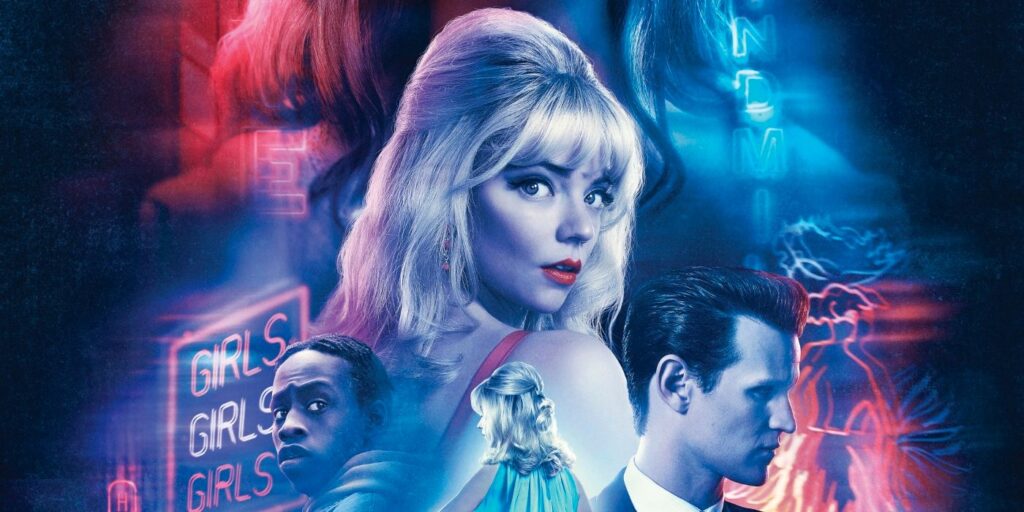
The latest film from the amazing mind of Edgar Wright (Shaun of the Dead, Baby Driver), Last Night in Soho, sets out to test the boundaries of what’s possible within a genre. With the appearance of an ordinary murder mystery on the cover, the story quickly turns to a horrific blood bath of time travelling chaos and confusion. With an impressive cast including Matt Smith (Doctor Who, The Crown), Anya Taylor-Joy (Split, The Queen’s Gambit), and most importantly, Thomasin McKenzie (Jojo Rabbit, The King), the narrative throws you in the deep end and holds you there until the credits roll.
Upon watching, while you can’t immediately identify the director’s style, you can tell straight away that the music shaped the narrative. The songs set the tone and pace for each scene and it feels as though the songs act as a beat sheet for the story, and the songs flow nicely from one scene to the next. It is clear this is how the film was made which must have made for an unusual and interesting pre-production stage as song inclusions usually depend on what the story is.
The narrative was intriguing and engaging, and despite a sprinkle of predictable moments, such as the identity of Miss Collins, the story kept the audience unaware of it’s next move. This made for a well structured roller coaster of events, in line with the director’s iconic style. An impressive feat the story largely pulled off was to use the thought process of the main character Eloise to mislead the audience and their perception of events, resulting in an interesting example of shared suspense, in which both the character in question and the audience are unaware of a threat to said character. It’s utilisation here makes perfect sense and fleshed out the storyline.
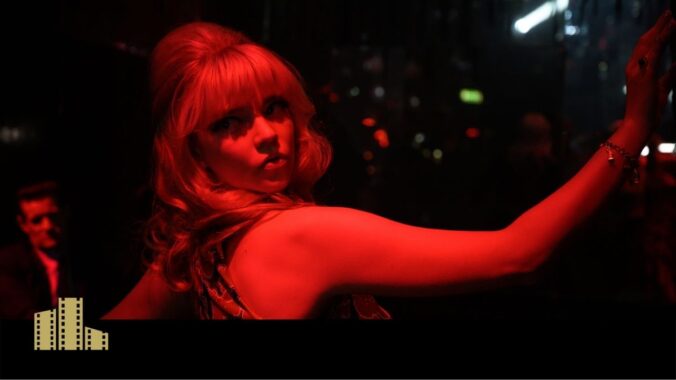
Despite Edgar Wright being synonymous with iconic comedies, he injected horror into this film with a steady hand, and it paid off. The cinematography is mesmerising throughout and really envelopes the audience in the world presented, trapping them in both the dreams and nightmares experienced by Eloise as she falls down the emotional rabbit hole of ecstasy and despair. The atmosphere created by the cinematography was almost suffocating at points when the narrative leaned heavily on horror.
The close-up shots make the audience claustrophobic, longing for the escape of long shots, however, even when this is offered there was no escape to be had. Instead, the streets of London, that once emitted a chance at a fresh start, now present a maze with no exit. A notable technique the film did perfectly was the Texas switch. A series of these are used in the dancing sequences, and are done seamlessly, which is impressive. Another clever technique which won’t be disclosed here is how the mirror scenes where shot. One certainty is the final scenes look excellent.
There is an abundance of great acting talent presented, with stand-outs for me coming from the main three; Thomasin McKenzie, Anya Taylor-Joy and Matt Smith. All three actors have unique things to offer when it comes to portraying their respective characters. Thomasin portrays an accurate and down-to-earth representation of a student in their first year of University, and all the thoughts and challenges that come with it. This helps to make the character relatable and forces the audience to care for them, and invest in their story.
Anya’s portrayal of Sandy is amazing. In addition, her singing is beautiful and captivating, which it has to be to win over Jack (Matt Smith), but now has the added bonus of winning over the audience too. Her rendition of Downtown is extremely memorable and is sure to stick in your head for weeks after you leave the cinema. That is impressively the case for most of the songs included. Matt Smith gives the audience another compelling performance that reminds us he is more than Doctor Who. He portrays Jack perfectly and in such a way that lures the audience in, before showing them the true nature of his personality.
Another impressive feat this film achieves is the transformation of London into it’s 60s self, and the attention to detail. All of the props, costumes, make-up and locations really help to sell the illusion of it taking place sixty years ago, which is obviously an important factor, as if it hadn’t been achieved, then the film likely wouldn’t work. The film essentially does what this sort of cinema is all about. It transports the audience into the universe created, and withholds opportunities to distinguish their reality from this one.
Another thing that adds a lot to the spirit of the film is that it was shot on location in Soho and other areas in London. This is an impressive aspect due to the life that shines out of the capital around the clock, and so knowing the effort that was put into the film and it’s locations, this factor just gives it extra personality and authenticity.
Overall this is an incredible film and an incredible feat of filmmaking, that all combines to create an immersive and personal experience for the audience that they are unlikely to forget for some time. The director’s gamble of trying something different pays off, and fans of his filmography should enjoy this progression.


Leave a Reply