
It’s easy to lose yourself in the rhythm of great music. That pull – so central to rave culture (alongside a few less legal influences) – offers an escape from everyday life, a chance to dissolve into the dance and the crowd around you. But what happens when that urge to get lost leads somewhere far darker, a desolate, unforgiving landscape at the edge of despair? It’s this journey, this “path,” that forms the spiritual core of Sirat.
Continue readingAuthor: Finley Kettle (Page 1 of 4)

After one of the boldest, most inventive marketing campaigns for an “independent” film in recent memory, does Marty Supreme, A24’s unhinged Ping-Pong picture live up to the hype?
Directed by Josh Safdie, Marty Supreme follows the exploits of an American table-tennis prodigy in the 1950s, but don’t let that simple synopsis fool you… Marty Supreme is far from a conventional sports flick. Instead, Marty is no plucky underdog or inspirational hero; he’s a narcissistic, arrogant scumbag who’ll stop at nothing to achieve his aspirations. The film’s tagline, Dream Big, is fully embodied in its lead character, but his actions are far from inspirational.
Continue reading
Who could have guessed that one of 2025’s most intense cinematic showdowns would unfold to the sound of Katy Perry’s 2010 anthem “Firework” – all set against the chaotic backdrop of the COVID pandemic? It’s a scene so wild, so emotionally charged, and so pivotal to the film that only the twisted brilliance of Ari Aster could have dreamed it up.
Few characters embody the feeling of being “a plastic bag, drifting through the wind” quite like Sheriff Joe Cross (Joaquin Phoenix) in Eddington, Aster’s latest American neo-nightmare. As the sheriff of a remote New Mexico town, Cross is caught in a whirlwind of conspiracy, paranoia, and unrest during the volatile days of May 2020. From COVID mandates to BLM protests, he’s pulled in every direction – struggling to hold his town together save his crumbling marriage, and match wits with his rival: the charismatic town mayor Ted Garcia (Pedro Pascal).
Continue reading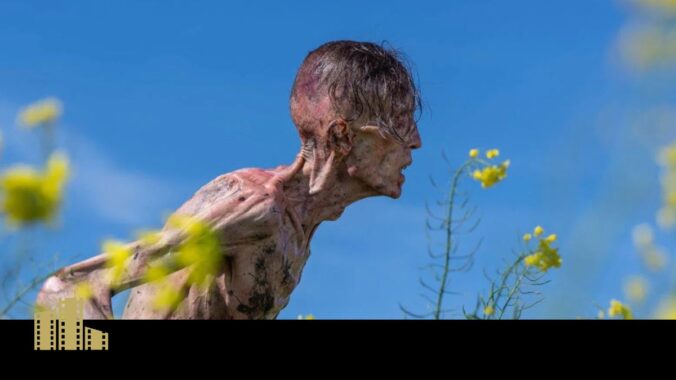
Nearly three decades after the Rage Virus first plunged Britain into chaos, 28 Years Later claws its way back into the cinematic spotlight—this time with original creators Danny Boyle and Alex Garland reunited at the helm. In the years since 28 Days Later redefined the zombie genre, we’ve seen a less memorable sequel (28 Weeks Later), Brexit, and a global pandemic that eerily called back to Cillian Murphy’s walk through a desolate London. Strangely, the legacy of 28 Years Later feels more intertwined with those real-world upheavals than with its own cinematic predecessor.
Set on the isolated island of Lindisfarne, the film introduces us to Jamie (Aaron
Taylor-Johnson), a hardened father, and his son Spike (Alfie Williams), who’s about
to face the infected mainland as a kind of apocalyptic rite of passage. His mother Isla (Jodie Comer), remains behind—sick, vulnerable and deeply affected by years of isolation. What follows is a harrowing, emotional, and at times dreamlike journey across a Britain left to rot in stasis.

War is hell. But we knew that right? We’ve all seen Saving Private Ryan or Apocalypse Now – films that portray the brutality of war, and the physical and emotional toll that takes on those involved. These are films that are ultimately narratively driven.
They tell a fictional story set within conflict, that aims to portray that conflict in an accurate and informed way. A24’s Warfare is different. Where films like Platoon or All Quiet on the Western Front focus on characters experiences or an engaging narrative, Warfare aims for the truth. A truth based on the memories of those who lived through hell.
Continue reading
I’ll never forget the first time I saw Jonathan Glazer’s Oscar winning film, The Zone of Interest. I was visiting a friend in Sheffield – the weather was obviously bad so we decided to go to the cinema and watch the new Holocaust movie – how very cheerful of us…
Continue reading
In a film full of bursting bodies and giant needles who would’ve thought that a man eating shrimp would be the scene that got the most visceral reaction out of me. Coralie Fargeat’s body horror film The Substance, made waves at Cannes before opening to unsuspecting audiences worldwide. You may have noticed two things if you were lucky enough to see this in a cinema. One, being that a couple probably left halfway through because they couldn’t hack it and two, that this is a messed-up rollercoaster of emotions that not-so-subtly bludgeons the audience with its themes of beauty standards, stardom and addiction – in the best possible way.
Continue reading
Zendaya, Josh O’ Connor and Mike Faist are caught in a psychosexual tennis trifecta of desire in Challengers, a film that plays out as an erotic thriller set to the framework of high-stakes professional tennis. It’s a strange mix of genre and style, but Challengers is an excellently crafted film that explores the complex relationships of its three central characters.
Continue reading
In Alex Garland’s dystopian action-thriller Civil War, a group of photojournalists are pinned down in a game of cat and mouse between two sniper shooters. One of the journalists asks “What side are you fighting for?” to which the laser-focused soldier replies, “Someone is trying to kill us. We are trying to kill them”. This is nearly all the context we are given in this war-torn vision of modern day America. Civil War isn’t concerned with politics and ideologies, instead the focus is on the conflict itself and those involved, specifically the journalists risking their lives to tell the truth.
Continue reading
By now, most of us are familiar with the spicy sand that covers the desert planet Arrakis, its gargantuan worm inhabitants and the Fremen that live alongside them, but for a long time the 1965 Sci-fi novel was deemed “unadaptable” by Hollywood. Filmmakers like David Lynch and Alejandro Jodorowsky have attempted to bring the psychedelic space fantasy to the big screen.
At the same time, a couple of mini-series have managed to tell portions of the expansive story on a smaller budget, with ultimately mixed results. Dune had proved to be too huge in scale to do justice, not until technology had evolved and more inspired filmmakers had emerged, did Dune finally find its place in cinema.
Continue reading
