
Emma Seligman’s female-run comedy Bottoms is a camp reimagining of Fincher’s Fight Club: but with minimal dick swinging. Toying with the harmful stereotypes surrounding gender that have orbited conversations surrounding the original, Seligman weaves the narrative of two lesbians hellbent on setting up a self defence class in the hopes of losing their virginities to their cheerleader crushes.
The slick dynamic between Ayo Edebiri and Rachel Sennot comes only with the easy familiarity of having risen in comedy together. Sennot plays the wildly chaotic PJ, hammering each punchline home with wild gesticulations and expressions, whilst Edebiri rehashes her regular straight-laced humour through the guise of Josie. Edebiri’s timing anchor’s Sennot’s wildness, often transforming the chaos into a manageable goofiness.
But American comedy still seems packaged with the rampant danger of allowing a joke to extend far past its expiration date. Perhaps my belief that a joke should be best enjoyed dry and snappy stems from my British sensibilities. But whilst Bottoms has several comedic gems spotted throughout the film- and never loses the rawness that generates the original appeal- the pacing of the film is often damaged in unavoidable ways.
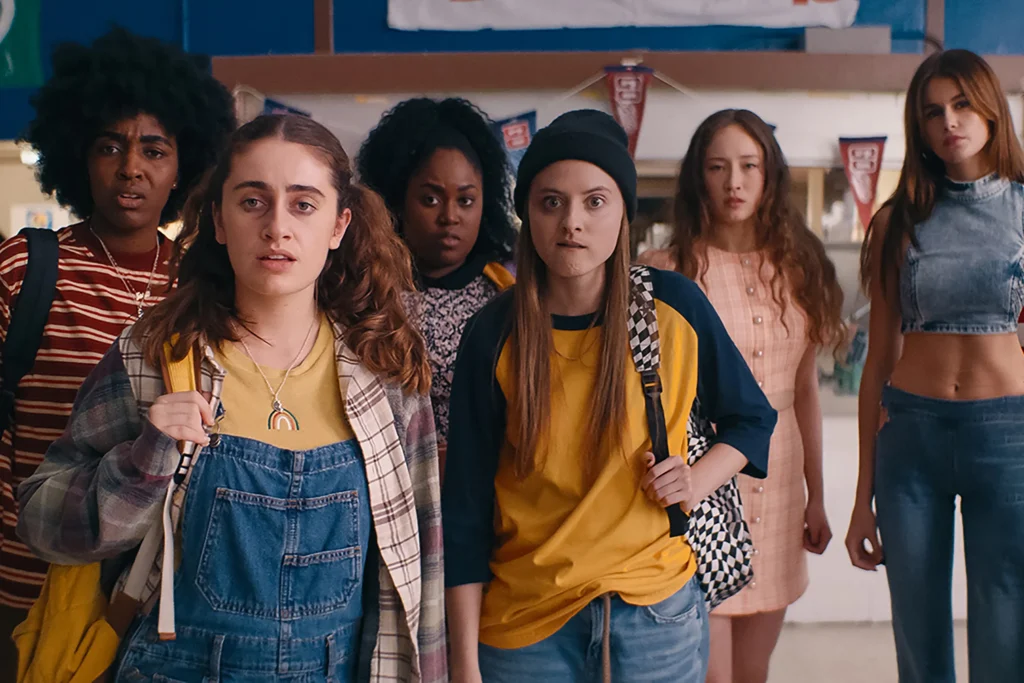
Sennot and Seligman’s world is super stylistic, constantly bordering on an aesthetic seemingly midway between an arthouse film and an exaggerated theatre production. The characters and their setting is founded on the influence of writer’s room insurgency that can only truly exist in comedy.
Both writers refuse to be restricted by the boundaries of narrative standards, especially that stereotypical of teenaged coming-of-age stories. Bottoms is a kooky film with kooky happenings that you never quite understand the limits of. From the incompetent star quarterback Jeff’s outrageous outbursts to disinterested teacher Marshawn Lynch struggling through his divorce, the world is populated by jocks and nerds so unreasonable they cannot be real, yet act as caricatures of people you have had the misfortune of dealing with.
Spearheaded by two LGBTQ protagonists with un-feminist intentions, Bottoms soars in Sennot and Edebiri’s natural dynamic but piques interest in it’s ability to touch upon identity politics in a non-coded way. It manages to be inclusive whilst not putting gay characters on a pedestal, which is a tightrope that the industry often seems incapable of balancing upon. I don’t want to say the moral of Bottoms is that gay women can be horny and try and f*ck cheerleaders just like men, but, I mean, I guess, it weirdly kinda is.
“I’d rather just see gay characters being gay or queer, and not having that be the plot” Seligman noted in an interview, “get that out the way, and then you can just have a regular movie”. Such subversions are precisely where the comedy flourishes, gleefully confusing us with what the film’s message is surrounding femininity, or if it even has one.
The characters are rarely held to real life expectations in their physical or emotional actions: and the script regularly attempts to make the audience feel uncomfortable as we experience the complexing morality of PJ and Josie. But as with any coming-of-age film, our heroines must grow up by the end. Momentarily we are reminded of the conventions necessary to streamline any narrative towards a satisfying conclusion as there is character development towards the conclusion. Whilst this feels like an unnecessary attempt to adhere to more generic film conventions, it is happily and quickly overpowered by a spectacularly bizarre ending which quickly reinstates the outlandish tone that makes the film so enjoyable. In a world that is too insane to always be held to the standards of reality, it’s admittedly difficult to find an appropriate way to grant the audience closure.
Spectacularly off-beat and unapologetically weird, Seligman and Sennot have created the type of comedy we rarely get to see anymore. The humour is allowed to colour outside the lines in a manner which breeds uncertainty as to the reality of the world, but does not effect our relationship to our enjoyment of it. Each joke may not always hit the nail on the head, but Bottoms feels almost groundbreaking in its ideas and aesthetic. At the very least, its honesty could certainly teach other film-makers a thing or two.
Take a look through our list of the best LGBT mainstream movies!


Leave a Reply